As most readers probably know, a Juris Doctor (Latin for “Doctor of Law”), or J.D., is the standard professional degree for lawyers in the U.S. Fortunately, most lawyers do not, without further education, walk around insisting that they be called “doctor.” A small mercy from a profession that tends to attract big egos.
In addition to J.D.s, many American law schools grant the academic degree of “Master of Laws,” or LL.M., shorthand for the Latin Legum Magister. J.D. holders who wish to specialize and foreign-trained lawyers who want additional grounding in American law often opt for this degree. While scholarly and respectable, the LL.M. itself is not ordinarily enough to make someone a lawyer in the United States.
In one of those marvelous little coincidences, “LLM” also happens to be the abbreviation for “large language model,” the currently dominant form of consumer-facing generative AI. But neither you nor the models themselves should be fooled: being an LLM isn’t the same as having an LL.M., or a J.D. for that matter.
You might think that last point was so obvious that it need not be said, but my direct personal experience suggests that is not so. Twice within the last nine months, one particular AI assistant has framed outputs delivered to me as if it were qualified to dispense legal argument or advice: the first time, when it referred to me chummily as a “fellow J.D.,” and the second when it was waxing philosophical and making observations about the things that “we lawyers” do in “our” professional lives.
Excuse me, I thought, but who the hell is 'we'?
This was not merely an annoying stylistic tic. Michigan law has long prohibited corporations and unlicensed persons from holding themselves out as entitled to practice, or furnishing legal advice in a way that crosses into the practice of law. The point of those restrictions is not to pad lawyers’ hourly billing; it is to protect the public from untrained legal counsel, unreliable legal advice, and confusion about who is actually accountable for the advice being given.
To be clear, I am not suggesting that every chatbot’s awkward turn of phrase is a clean unauthorized-practice-of-law case. The statutory framework was not written with large language models in mind, and no Michigan court has yet had occasion to apply it to a general-purpose AI assistant that starts talking like it belongs in the lawyers’ lounge. But the instinct behind the statute matters. When an AI system tells a user “as lawyers, we tend to…” it is not simply being friendly. It is borrowing professional identity, and with it some of the trust that belongs to actual human beings with legal education, licensure, duties, discipline exposure, and accountability.
That is the vendor-side problem. There is also the lawyer-side problem.
In recent years, more than a few attorneys have given in to the temptation to rely upon AI outputs without thoroughly vetting the content before submitting it to a court, and some of them have paid a heavy professional price. On June 17, the Michigan Court of Appeals sanctioned an attorney who had built an appellate brief on citations his AI research tool invented. That alone would be an unremarkable entry in a growing genre—American courts have now sanctioned numerous lawyers for versions of the same thing—except for what happened next.
Confronted with the problem, the attorney filed a “Notice of Correction,” which was—you guessed it—also written with the aid of AI, and also contained fabrications.
The panel’s opinion was almost blasé about the situation: “Artificial intelligence may be a useful tool for legal research and drafting, but the use of such technology does not alter an attorney’s professional obligations.” No new rule was needed. The old one—the duty of reasonable inquiry under MCR 1.109(E)(5)—already covered it. Lawyers remain responsible for the filings they sign and submit. They must verify that cited authorities exist, read the authorities on which they rely, and ensure that those authorities support the propositions asserted.
That is the easier scenario. Fake cases are fake cases. A competent lawyer should catch them. A court does not need a new philosophical framework to sanction an attorney who files invented authorities, then responds to the problem with more invented authorities.
The harder problem is what happens when the AI does not hallucinate.
While I was writing the first draft of this article, an LLM confidently told me that a throwaway parenthetical comment I made about AI misrepresentations and consumer protection law was wrong. The model’s facial analysis of the case law was accurate, but it was done without the benefit of nearly 25 years of practicing law or firsthand knowledge of the political context of the cases it was quoting—things that I possessed and that it could never discover with legal research alone.
Despite not having any lived experience, a legal education, or credentials, the AI doubled down, saying that my inference was wrong and insisting that I defend my position.
“Shut up,” I explained.
I exaggerate, but only slightly. I did in fact articulate the basis for my view in more detail. When I was finished, the model agreed that it had been overconfident about its assertions. It had not known what it did not know.
That episode is more interesting to me than the familiar fake-citation cases. The model had not simply invented law. Its analysis was facially plausible. Its authorities were real. Its reasoning had a certain lawyerly shape. But it lacked context, judgment, and the professional humility to recognize when a licensed attorney was identifying a problem that could not be solved by reading the next case in the chain.
This is where AI risk in law becomes more subtle. The danger is not only that a model may fabricate a case, quotation, or statute. The danger is that it may accurately summarize real authorities, arrange them into a persuasive argument, and still be wrong in the way that matters. That kind of error is harder to detect because it does not look like nonsense. It looks like research.
Perhaps the best question is not “did AI touch this?” but “who owns the final work, and what process makes that ownership meaningful?” Law’s emerging answer is not that AI can never be used. It is that AI-assisted work must still be owned by someone with actual duties, actual judgment, and actual accountability.
The State Bar of Michigan’s AI guidance takes this approach. Lawyers must understand the technology they use. They must protect client confidences. They must check citations and source materials. They must not mislead courts, clients, or opposing parties. They remain responsible for all legal documentation, whether drafted by their own hand, by staff, or through a technological program. In other words, AI does not create a separate ethical universe. It enters the one lawyers already occupy.
New York’s court system has moved in a similar direction through Part 161 of its statewide court rules. Effective June 1, 2026, Part 161 says that AI use in preparing court papers should not be prohibited, and that attorneys and parties should not have to disclose it merely because AI was used. The rule then supplies a model provision that individual courts may adopt. Under that model, AI users are expected to understand the tool’s capabilities and limitations. They must carefully review the work and independently ensure that the paper contains no fabricated or fictitious cases, statutes, or other material; by signing, they certify that this review was conducted.
That is the right frame. If a junior associate drafts a brief, the signing lawyer is still responsible. If a paralegal prepares a filing, the lawyer is still responsible. If a search engine, treatise, template, citation tool, or AI assistant helps produce the work, the lawyer is still responsible. The tool may change the workflow. It does not move the duty.
That principle matters beyond law. In Part One of this essay series, I discussed a State of Michigan job posting that appeared to prohibit applicants from using AI anywhere in the selection process, even as the state’s hiring portal was hosted by a vendor advertising AI-enabled government HR software. That kind of posture asks the wrong first question. It treats the use of AI by individuals as inherently suspect while accepting, or at least tolerating, AI use by institutions and vendors.
For lawyers, ownership means professional judgment, verification, candor, confidentiality, and accountability. For government agencies, it should mean transparent rules, human review, clear lines of responsibility, and a meaningful ability to challenge automated or AI-assisted outcomes. For schools in particular, as I shall discuss in Part Three, it should mean something similar: not detector-driven whack-a-mole, but a renewed focus on whether students understand, can explain, and can stand behind the work submitted under their names.
Prohibition and panic are self-defeating. The answer is not “never use AI.” Nor is it “confess that AI touched the document.” The answer is that AI-assisted work remains the responsibility of the human professional who uses it.
That is not a perfect solution. But it is a much better starting point than pretending the tool does not exist, outsourcing judgment to the tool, or treating every use of the tool as misconduct. AI can assist professional work. It cannot become the professional. And when it forgets that, someone with a J.D.—preferably one who has read the cases—still needs to be in the room.
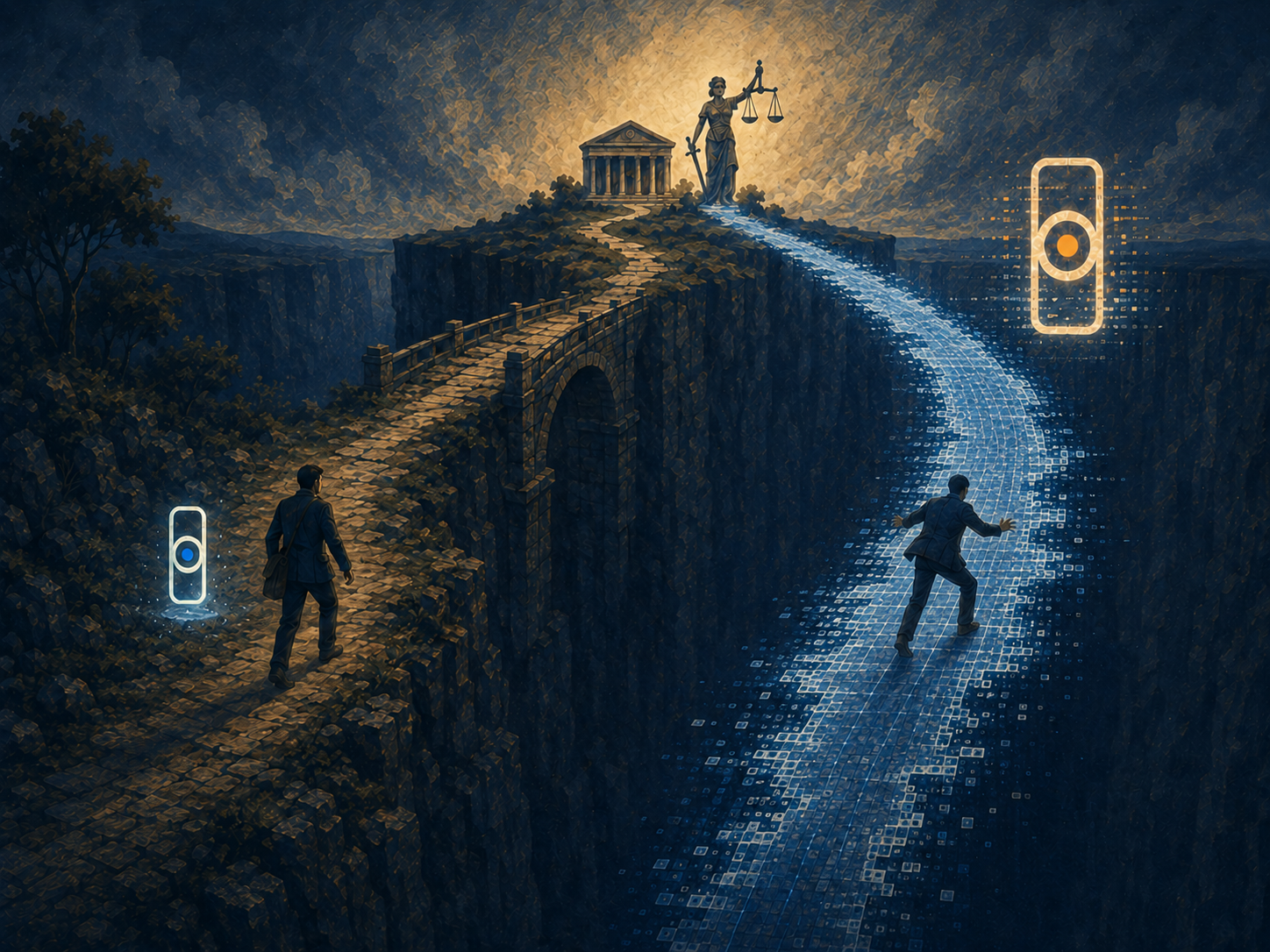
This essay was edited for clarity after initial publication. Part Three will lay out a practical path forward for public institutions and agencies. Illustration created by the author with the assistance of generative AI.